Agentic Talent Intelligence: The Category Nobody Named Yet
Agentic Talent Intelligence is an emerging category redefining hiring with AI-driven decision systems

Agentic Talent Intelligence: The Category Nobody Named Yet
Every transformative software category gets named twice, once by the founders building it, and once by the analysts validating it. The window between those two moments is where category leaders are made.
In 2010, Marc Benioff didn’t just build Salesforce. He named a category “cloud CRM” and spent the better part of a decade making sure every analyst, journalist, and enterprise buyer associated that phrase with one company. The category name became the moat.
In 2015, a group of security founders coined “endpoint detection and response.” EDR wasn’t a product feature. It was a forcing function, a clean conceptual boundary that told the market: everything before this was reactive, everything after is intelligent. CrowdStrike didn’t win because it had better code. It won because it owned the vocabulary first.
We are at that moment in enterprise talent acquisition. And nobody has named it yet.
The Problem With Every Label We Have
Walk into any F500 CHRO’s office and ask them what software runs their hiring. They’ll point to an ATS, Workday, Greenhouse, Lever. Ask them what intelligence runs their hiring, and they’ll pause. Because the answer, today, is: nothing systematic.
The existing category labels are all wrong for what’s being built now:
The reason none of these labels fits is that they were all coined before the underlying technology could do what it can do today. They described the world of workflow software, not intelligence infrastructure.
What “Agentic” Actually Means Here
Agentic AI is not a chatbot. It’s not a copilot. It is a system that perceives inputs, reasons across them, takes sequential actions, and produces outputs without requiring a human to approve each step.
In the context of talent acquisition, that distinction matters enormously. Today’s AI recruiting tools are assistants. They help a recruiter write a job description faster. They surface a ranked list of resumes. They schedule a calendar invite. But the human is still the decision engine. The AI is the keyboard.
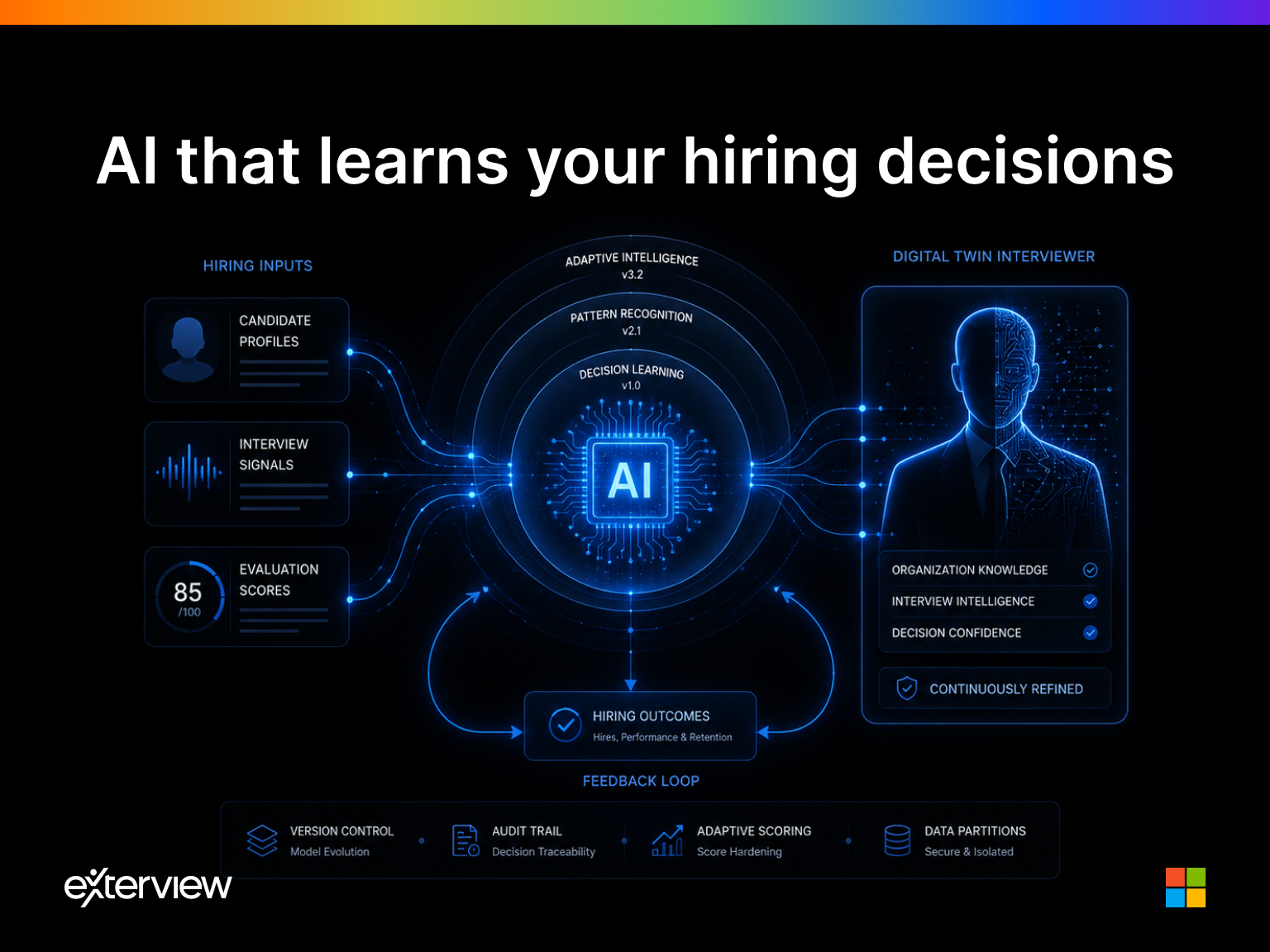
Agentic Talent Intelligence flips this. The system runs the evaluation end-to-end from generating a calibrated assessment to conducting a structured interview, scoring behavioral signals, detecting inconsistencies, benchmarking against role-specific norms, and delivering a ranked recommendation with full auditability. The human reviews an output. They don’t operate a process.
“The shift from AI-assisted hiring to agentic talent intelligence is the same shift that happened between spell-check and large language models. One assists. The other reasons.”
This is not a marginal improvement. It is an architectural change in how hiring decisions get made at scale.
Why Now
Three infrastructure curves converged in 2023 and 2024 that made this category technically possible.
Foundation models with reasoning capability. GPT-4 and its successors can hold a multi-turn conversation, evaluate responses against a rubric, and generate structured assessments. This wasn’t true at the capability level two years ago.
Multi-agent orchestration frameworks. LangGraph, AutoGen, and proprietary agent runtimes now allow multiple specialized agents to run in coordinated sequence each owning a discrete evaluation function without collapsing into a single monolithic model call. This enables the kind of modular, auditable pipeline that enterprise compliance teams will demand.
Enterprise readiness of AI infrastructure. Azure OpenAI, AWS Bedrock, and Google Vertex now offer the SLA, data residency, and security controls that make deploying AI agents inside F500 environments a procurement conversation rather than a security red flag.
Key market signals:
- $780B — Annual global cost of bad hires
- 67% — Of hiring decisions driven by gut feel
- 9 — Agents required to replace one end-to-end hiring workflow
The Nine-Agent Architecture as Category Blueprint
One of the reasons category definitions stick is that they come with a structural model, a way of thinking about the problem that competitors must either adopt or argue against. EDR had its kill chain. Zero Trust had its perimeter-less model. Agentic Talent Intelligence has the nine-agent pipeline.
In the architecture we’ve built at Exterview, each agent owns a discrete function: assessment generation, pre-screening, technical evaluation, behavioral interviewing, communication scoring, anti-gaming detection, bias normalization, benchmark comparison, and final recommendation synthesis. No single agent does everything. Each is specialized, auditable, and replaceable.
This matters for the category definition because it establishes the minimum viable architecture for any serious player in this space. You cannot build Agentic Talent Intelligence with a single model call. You cannot build it with a copilot wrapper. You need a pipeline. And the pipeline is the product.
The Enterprise Forcing Function
Categories don’t get validated by founders. They get validated by buyers. And the buyers in this category F500 CHROs, CPOs, and talent acquisition leaders are under pressure that is accelerating the adoption curve faster than most people expect.
Three forces are converging on enterprise talent leaders simultaneously. First, the cost of mis-hires at senior and technical levels has become a board-level conversation as headcount growth slows and productivity per employee becomes the primary efficiency metric. Second, DEI compliance and equal opportunity hiring now require defensible, auditable hiring decisions which gut-feel interviewing cannot provide. Third, the talent market is global, which means the volume of qualified candidates is growing faster than the interviewer capacity to evaluate them.
Each of these forces independently creates demand for intelligence infrastructure over process tooling. Together, they create a category-level pull that no amount of product marketing could manufacture.
Who Names the Category, Owns the Category
This is not a prediction. It is a historical pattern. The companies that define the vocabulary of a market that get their terms into analyst reports, procurement RFPs, and job descriptions. Create durable advantages that outlast any individual product feature.
When a CHRO reads a Gartner report in 2026 and sees “Agentic Talent Intelligence Platform” as an emerging category, the companies that have been using that language for two years will have a structural head start. Not because of brand awareness. Because the category definition itself encodes their architectural assumptions.
We are naming this category now. Not because we own it yet, but because the window to define the terms is open, and open windows close fast.
The next generation of enterprise hiring infrastructure will not be called AI recruiting. It will not be called smart ATS. It will be called Agentic Talent Intelligence and the companies that understand why will be the ones building it.
The rest will be features inside someone else’s platform.
Exterview’s nine-agent architecture replaces the end-to-end hiring evaluation workflow from assessment generation to final recommendation with a fully auditable, AI-native pipeline.