From Gut Feel to Scored Signal: How F500s Will Hire in 2027
Hiring is shifting from intuition to data-driven, scored evaluation

From Gut Feel to Scored Signal: How F500s Will Hire in 2027
In 2027, the CHRO of a Fortune 500 company will sit in a board meeting and present hiring outcomes the same way the CFO presents revenue outcomes: with precision, with attribution, with a clear line from input to result.
They will show the board not just how many people were hired, but how those hires were evaluated, what competencies were tested, how each candidate scored against validated benchmarks, what the model predicted about 12-month performance, and whether those predictions held. They will show the demographic composition of the evaluation pipeline alongside the demographic composition of the outcome, and they will demonstrate statistically that the two are not correlated in ways that create legal exposure.
This is not a speculative scenario. It is the logical endpoint of a transition that is already underway. And the companies that understand where it ends will make better technology decisions today.
The Talent Accountability Gap
Every other major business function has been transformed by the shift from intuition to instrumentation. Finance moved from ledgers to ERP to real-time analytics. Sales moved from rolodex to CRM to revenue intelligence. Marketing moved from brand intuition to multi-touch attribution to AI-optimized spend.
Talent acquisition has remained the last holdout. In most F500 organizations, the hiring process generates less structured data than a single Salesforce opportunity. The most important decisions a company makes, who joins, who leads, who builds are made with less analytical rigor than decisions about which keywords to bid on in a Google search campaign.
This is changing. Not because HR leaders suddenly want more data, but because the business consequences of hiring failure have become too large and too visible to absorb without accountability.
Three Forcing Functions
The cost is becoming undeniable. The fully-loaded cost of a mis-hire at the manager level recruiting, onboarding, ramp time, productivity loss, departure, and replacement routinely exceeds $500,000 at large enterprises. As headcount growth has slowed and productivity per employee has become the primary efficiency metric, CFOs are applying the same scrutiny to hiring ROI that they apply to marketing ROI. Gut feel is not a defensible answer to a CFO question.
The legal environment is tightening. The EU AI Act introduces mandatory transparency requirements for AI systems used in employment decisions. US states including Illinois, Maryland, and New York have passed or are actively legislating AI hiring regulations. The direction of regulatory travel is clear: hiring decisions will need to be explainable, auditable, and demonstrably free of discriminatory patterns. Unstructured human interviews, ironically, are harder to defend under these frameworks than well-documented agentic evaluations.
The talent market is globalizing. Remote work and global talent platforms have expanded the addressable candidate pool for most F500 roles by an order of magnitude. A company that once reviewed 200 applications for a senior engineering role may now receive 2,000. The interview capacity constraint, the number of hours senior engineers can spend evaluating candidates has not expanded proportionally. Something has to give. Agentic evaluation is what gives.
What the 2027 Hiring Stack Looks Like
The F500 hiring stack in 2027 will have three layers, each distinct in function and technology:
The System of Record layer (ATS Workday, Greenhouse, etc.) continues to handle workflow routing, compliance record-keeping, and integration with HRIS. It does not change fundamentally. It becomes the data store for structured outputs it no longer generates.
The Intelligence layer (Agentic Talent Intelligence Platform) handles all evaluation functions: assessment generation, structured interviewing, behavioral scoring, technical evaluation, bias normalization, and recommendation synthesis. This layer generates the signal that the ATS stores. It is the decision engine.
The Relationship layer (human recruiters, hiring managers) handles offer negotiation, cultural alignment conversations, candidate experience, and the relational aspects of bringing someone into the organization. This is not automated. It is liberated, freed from the administrative and evaluative burden that currently consumes most recruiter time.
The intelligence layer is the new battleground. And unlike the ATS market which consolidated around a handful of incumbents over twenty years, the intelligence layer market is forming now, in real time, with no established leaders.
What “Scored Signal” Actually Means
The phrase “scored signal” is worth unpacking because it is often confused with simple numerical ratings.
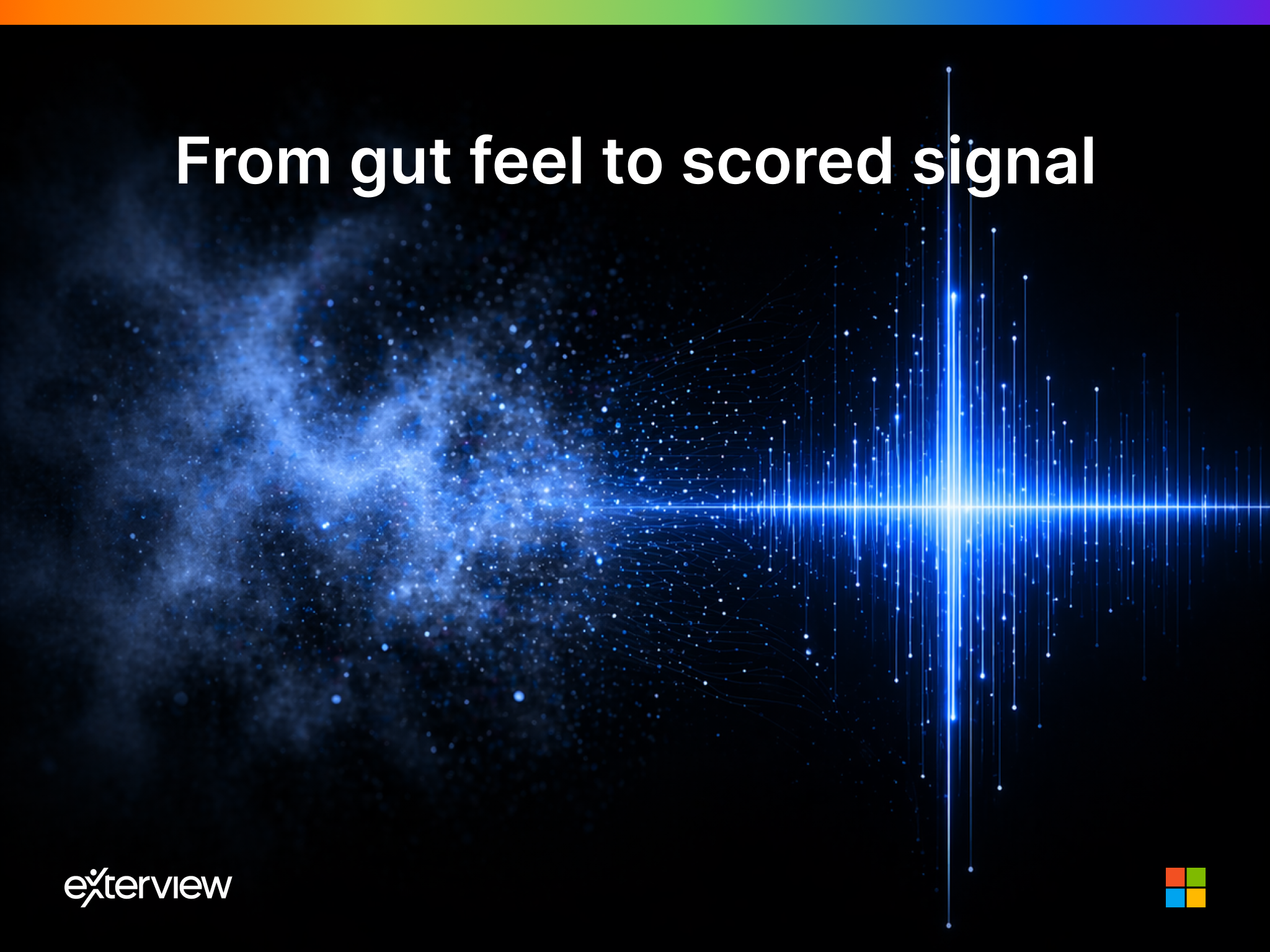
Scored signal is structured, multi-dimensional evaluation output that is comparable across candidates and predictive of outcomes. It includes: competency scores calibrated to role requirements, behavioral pattern classifications based on validated frameworks, communication quality indices, consistency flags that indicate potential integrity issues, and benchmark comparisons against relevant reference populations.
The key property of scored signal is comparability. When every candidate is evaluated through the same pipeline, the outputs can be ranked, analyzed, audited, and improved. When candidates are evaluated by different interviewers using different criteria with different scoring approaches, the outputs are noise dressed up as data.
Most F500 companies today have noise. The shift to scored signal is not an incremental improvement. It is a category change in how hiring decisions are made.
The Competitive Implication
Talent is the primary source of competitive differentiation for knowledge-intensive enterprises. This has been true for decades. What is changing is the precision with which that differentiation can be managed.
The company that builds a scored, structured, predictive hiring pipeline in 2025 and 2026 will have a measurable advantage in talent quality by 2027. Not because its individual hires will be dramatically better. But because it will know which factors predict performance in its specific context, it will be able to replicate successful hires systematically, and it will eliminate the variance that currently makes every hiring cohort a lottery.
The transition from gut feel to scored signal is not a technology upgrade. It is a competitive strategy. And in 2027, the companies that made it will be able to prove it.
Exterview delivers the scored, structured evaluation signal that transforms hiring from intuition to intelligence.